
Certificate of Origin from China: What Importers Need to Know
Updated 2026-06-20
Over 20 years of sourcing from China, I've seen too many importers lose money on duties simply because they didn't have the right Certificate of Origin. This document isn't just a formality—it can save you thousands in tariff reductions or prevent customs delays. Here's what you need to know to get it right.
What is the Certificate of Origin?
Generally speaking, a Certificate of Origin is a document that proves that the goods in a particular export shipment have been wholly obtained, produced, manufactured, or processed in a particular country. The name can be abbreviated to C/O or COO.
Why is a Certificate of Origin needed?
The origin of goods is essential for tax and tariff authorities (for example, duty is applicable when buying goods in country A but not in country B). For instance, while many Chinese products are exempted from duty, there are still some categories in which the target market uses duty as a protection tool. It is mainly used in cases of exporting:
- agricultural products
- products of animal origin
- textiles
- mineral products.
Types of COO
Generally, there are two types of Certificates of Origin.
Non-preferential Certificate of Origin
Non-preferential Certificate of Origin specifies the place of production, but the goods do not qualify for any exceptional treatment.
Preferential Certificate of Origin
Preferential Certificate of Origin means that the goods were manufactured in a country that has some trade agreement with the destination country (it refers, for example, to trade within the Commonwealth of Nations). Other special trading areas include the European Union, ASEAN, and NAFTA.
Who issues a Certificate of Origin?
Usually, the Certificate of Origin should be delivered by the Chamber of Commerce/customs administrations from a particular country. For example, for the goods exported from the USA, Certificates of Origin can be obtained from the US Chamber of Commerce.
You can obtain preferential and non-preferential certificates for a product, but you cannot get two original copies of one CO type.
How to get a Certificate of Origin in China?
In China, only a company with an export license is eligible to file the application for CO. The person who wants to obtain a Certificate of Origin should apply to:
- Entry-Exit Inspection and Quarantine Bureau (General Administration of Quality Supervision, Inspection and Quarantine of the People’s Republic of China, AQSIQ) – preferential COs
- China Council for the Promotion of International Trade (CCPIT) – non-preferential COs.
The application should be submitted at least five days before the shipment departs from China.
Chinese Certificate of Origin form A
Goods listed on Form A can get a tariff reduction if they comply with the GSP rules of origin of the recipient country. 39 destination countries have granted China GSP treatment: Austria, Belarus, Belgium, Bulgaria, Cyprus, the Czech Republic, Germany, Great Britain, Greece, France, Italy, the Netherlands, Luxembourg, Ireland, Denmark, Spain, Portugal, Sweden, Finland, Poland, Hungary, Slovakia, Slovenia, Estonia, Latvia, Lithuania, Malta, Romania, Switzerland, Liechtenstein, Norway, Russia, Ukraine, Kazakhstan, Japan, Australia, New Zealand, Canada, and Turkey.
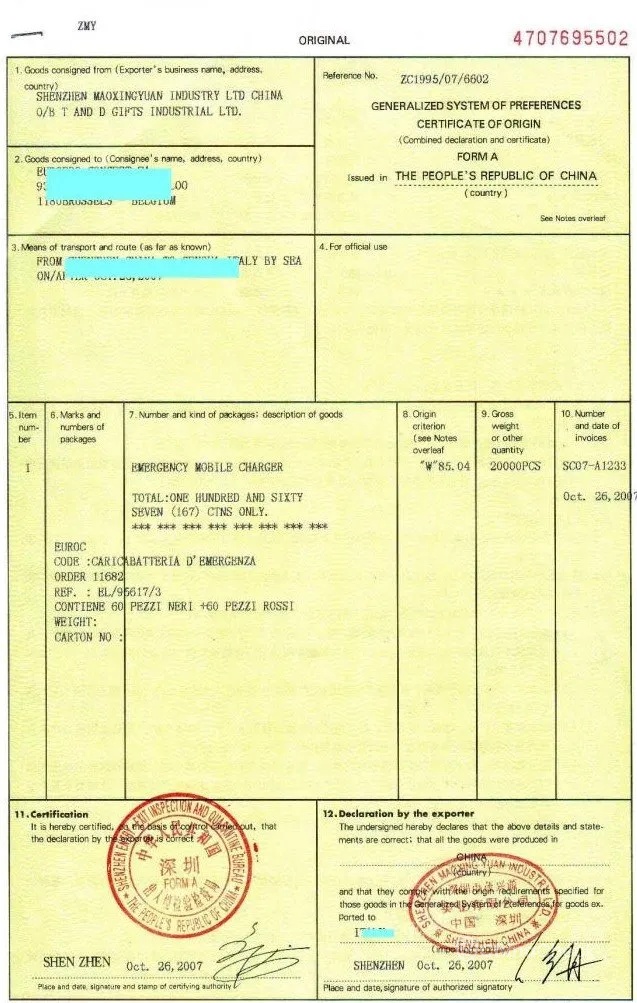 Chinese CO, form A: Generalized System of Preferences Certificate of Origin
Don't leave duty savings on the table. Ensure your supplier has the correct COO and export license before shipment. At China-Check, we verify supplier documentation and can help you navigate customs requirements—from factory audits to document checks.
Doing business with a Chinese company? Verify it before you commit
Run a verification →Verify before you pay
Get an independent due-diligence report on any Chinese company — registration, legal status, litigation and risk signals — delivered to your inbox.
Check a company now