
Importing EV Chargers from China to the EU: Complete Guide
Updated 2026-06-20
After two decades sourcing electronics from China, I’ve seen electric vehicle (EV) charger demand explode—and the smartest importers move fast. China’s manufacturing hubs in Guangdong and Zhejiang produce the bulk of the world’s EV chargers, but getting them into the EU requires more than just finding a factory. Customs duties are low (just 2.1%), but compliance with EU directives like EMC, LVD, and RoHS is non-negotiable. Let me walk you through the real-world steps to import chargers smoothly.
Where are EV chargers produced in China?
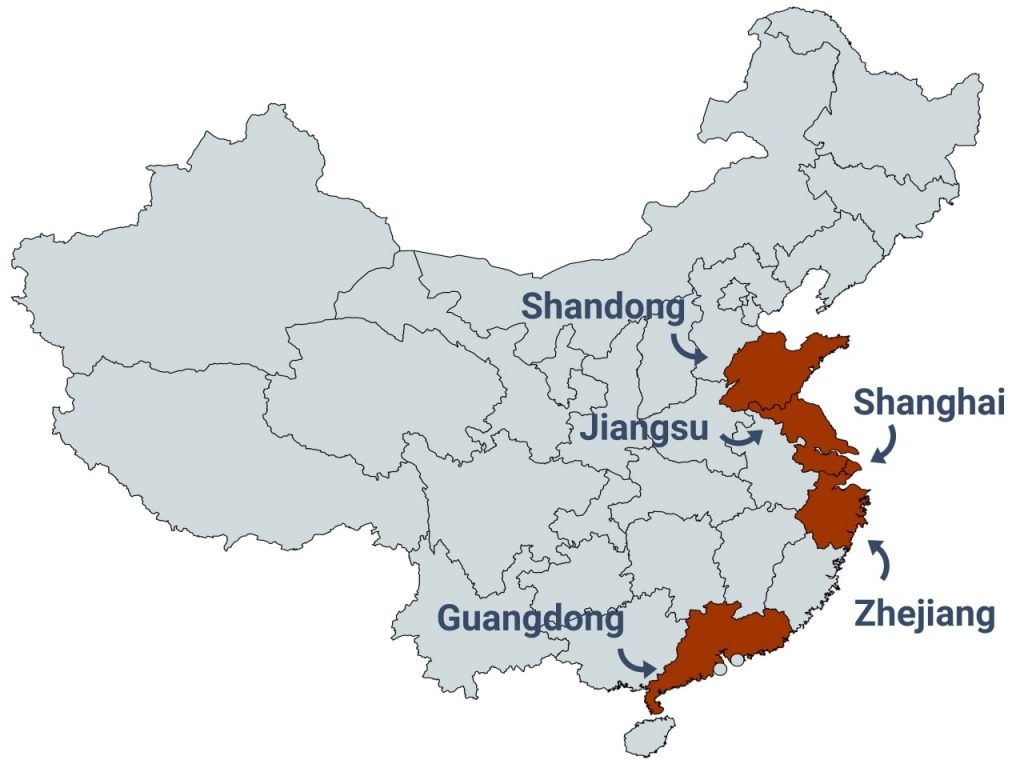
The most industrially developed provinces in China are Guangdong, Shandong, Jiangsu, and Zhejiang. It is no surprise that these provinces are China’s largest EV chargers’ manufacturers.
Electric car chargers in China are produced in:
- Guangzhou, Shenzhen (Guangdong)
- Qingdao (Shandong)
- Shanghai
- Nanjing, Changzhou (Jiangsu)
- Ningbo, Wenzhou, Jinhua, Hangzhou (Zhejiang).
Importing electric car chargers from China to the EU – duty rates
Customs duties are paid when trading goods based on the value of goods, customs tariff for the goods, and the origin of the goods. The tariff measures and other information are in the TARIC tariff system.
A vehicle charging station consisting of an outdoor enclosure, insulated electrical cables with charging connectors, and a user display interface in the tariff system is under the heading “boards, panels, consoles, desks, cabinets and other bases, (…) for electric control or the distribution of electricity, including those incorporating instruments or apparatus,” “programmable motor memory controller for a voltage not exceeding 1000 V comprising at least a printed circuit with active and passive components, an aluminum housing, and multiple connectors.”
The custom code for electric car chargers is 8537109170. The customs tariff for EV chargers for this code is 2.1%.
Importing electric car chargers from China to the EU – requirements
New products placed on the EEA market must comply with relevant laws, like directives and regulations. Moreover, some countries introduce national laws on specific products.
Make sure to attach a user manual and technical documentation to your electric car chargers.
EU regulations on EV chargers
EV chargers in the EEA have to comply with several EU laws:
1. Electromagnetic Compatibility (EMC) Directive
EMC Directive 2014/30/EU sets out the requirements for electronics that may cause an electromagnetic disturbance.
2. RoHS Directive
RoHS directive 2011/65/EU sets the rules on restricting the use of hazardous substances in electrical and electronic equipment (EEE).
3. Low Voltage Directive (LVD)
Directive 2014/35/EU of the European Parliament and of the Council mainly applies to electrical equipment with a voltage rating of between 50 and 1 000 V for alternating current and between 75 and 1 500 V for direct current.
4. Radio Equipment Directive (RED)
Directive 2014/53/EU on radio equipment regulates electrical or electronic product, which intentionally emits and/or receives radio waves for the purpose of radio communication and/or radiodetermination, or an electrical or electronic product that must be completed with an accessory, such as antenna, to intentionally emit and/or receive radio waves for the purpose of radio communication and/or radiodetermination.
5. REACH
Regulation (EC) No 1907/2006 of the European Parliament and of the Council concerning the Registration, Evaluation, Authorisation, and Restriction of Chemicals (REACH) applies to almost all product categories.
6. CE mark and declaration of conformity
The aforementioned EU laws require the EV charger to bear a CE mark. It is affixed after it was confirmed that the device is compliant with relevant directives listed in the declaration of conformity.

6. WEEE symbol
EV chargers have to be compliant with Directive 2012/19/EU (WEEE). It regulates the waste of electrical and electronic equipment by preventing, reusing, recycling, and other forms of recovery of such wastes to reduce waste disposal and contribute to the efficient use of resources and the retrieval of valuable secondary raw materials. Such equipment or its documentation must bear the WEEE symbol.

EV chargers trade fairs in China
Trade fairs are an ideal place to expand the professional network and stay up to date with innovations. Attending a trade fair in China is incredibly beneficial since face-to-face contact is preferred to build stronger guanxi.
A list of trade fairs in China in the electromobility sector:
Shenzhen International Electric Vehicle Exhibition
- Venue: Shenzhen – Shenzhen Convention and Exhibition Center, Shenzhen
- Website: szevexpo.com/index.php
- One of the main themes of the SHEVE is EV charging.
Hong Kong Electronics Fair (Autumn Edition)
- Venue: Hong Kong – Hong Kong Convention and Exhibition Centre, Hong Kong
- Website: event.hktdc.com/fair/hkelectronicsfairae-en/HKTDC-Hong-Kong-Electronics-Fair-Autumn-Edition
- Hong Kong Electronics Fair is one of the biggest in the area. Exhibitors present EV charging solutions.
China International New Energy and Intelligent Connected Vehicles Exhibition (IEEV)
- Venue: Beijing – New China International Exhibition Center, Beijing
- Website: evautoe.com
- IEEV is a complex fair and conference is devoted to electromobility and state-of-the-art technologies in that regard.
Wire & Cable Guangzhou
- Venue: Canton Fair Complex, Guangzhou
- Website: wire-cable-china.cn.messefrankfurt.com/guangzhou/en
- Wire & Cable Guangzhou is a massive fair organized by Messe Frankfurt. The scope of the trade fair are cables, wires, machinery, and accessories.
The bottom line: low tariffs and abundant Chinese suppliers make EV charger importing attractive, but skipping supplier verification can cost you weeks and thousands in non-compliance fines. Before you place that first order, invest in a factory audit and product testing through a trusted third party. China-Check’s supplier verification and quality control services have helped dozens of importers avoid counterfeit parts and delayed shipments—so your chargers arrive EU-ready on time.
- Venue: Canton Fair Complex, Guangzhou
- Website: cantonfair.org.cn/en
- Canton Fair is the largest trade fair in China, running since 1957. The biannual fair takes place during spring and autumn and is divided into three phases. The first phase focuses on vehicles, machinery, and electrical and electronic equipment.
Sourcing electric car chargers from China to the EU – to sum up
- EV charger manufacturers in China are mainly located in Guangdong province.
- The customs tariff on electric car chargers from China is low.
- Make sure that imported product complies with the requirements of the target market. In the EU, EV chargers must adhere to the LVD, EMC, RED, and WEEE directives, as well as the REACH regulation.
- We highly recommend verifying your chosen Chinese supplier before you place an order.
- Read our guides on import from China.
Doing business with a Chinese company? Verify it before you commit
Run a verification →Verify before you pay
Get an independent due-diligence report on any Chinese company — registration, legal status, litigation and risk signals — delivered to your inbox.
Check a company now