
AQL Sampling Explained: Quality Inspection Standards for Importers
Updated 2026-06-20
After two decades in China sourcing, I've seen countless importers lose money because they didn't understand the AQL (Acceptance Quality Limit) standard. It's not just a technical term—it's the difference between accepting a shipment that meets your quality expectations and ending up with a batch of defective products. Here's what you need to know to protect your business.
Why is the AQL norm important?
After AQL inspection, the importers know if the commodity passed through the check or not. Based on the given outcome, they can decide whether to keep or ditch the batch. If the amount of faulty goods is near the AQL standard, you, as an importer, should take into account the possible outcome. It may turn out that most of the commodities from that batch have defects as well.
If you are importing from China and are brokering end user, you should tighten up the AQL standards. In that way, you have the certainty that the commodity the end buyer receives will have as few faulty goods as possible and can undergo even more strict inspection.
What is the AQL norm?
The acronym stands for “Acceptance Quality Limit,” which means “quality level that is worst tolerable” (ISO 2859). In other words, it is the line between acceptance and rejection of a given product. It determines how many faulty commodities, on average, there are in proportion to a definite amount of examined samples and if this proportion fits in the standard average during the production.
What are the advantages of using AQL?
It gives importers assurance that the received commodity has satisfactory quality.
What are the categories of commodities’ defects and standard levels of AQL?
Defects are divided into three categories:
- Critical defect – does not meet the basic norms of safety; it may threaten a user’s life.
- Major defect – the user could return the product, as the products can get damaged easily or be less effective.
- Minor defect – slight deviance from the norm, but the user most probably will not return it.
Standard levels of AQL for commodities are
- Critical defects – 0%
- Major defects – 2.5%
- Minor defects – 4%
Depending on the category of product, acceptable percentage norms can differ.
How are samples chosen for inspection?
According to the chosen level of inspection’s accuracy:
- GI: Shorter time of inspection, but greater risk that commodity can be found faulty even after the inspection. Recommended for products that do not need such a rigorous check.
- GII: It is used when more rigoristic control is needed. It is the most popular one, the most often chosen level of inspection’s accuracy.
- GIII: Longer time of inspection, but a lesser risk of a faulty commodity.
How to use the AQL tables?
AQL norm is presented in the two tables. They were made based on international standards (ANSI/ASQC Z1.4, NF06-022, BS 6001, DIN 40080).
Table NO°1: On the left side, you can find a range of product quantities (lot sizes). You can find its given letter depending on the chosen level of inspection’s accuracy (defined as GI, GII, GIII).
Table NO°2: On the left side, according to the previously given letter, the number of samples is presented. The indicated number of samples will be checked. Levels of tolerance indicate the maximum number of commodities with defects.
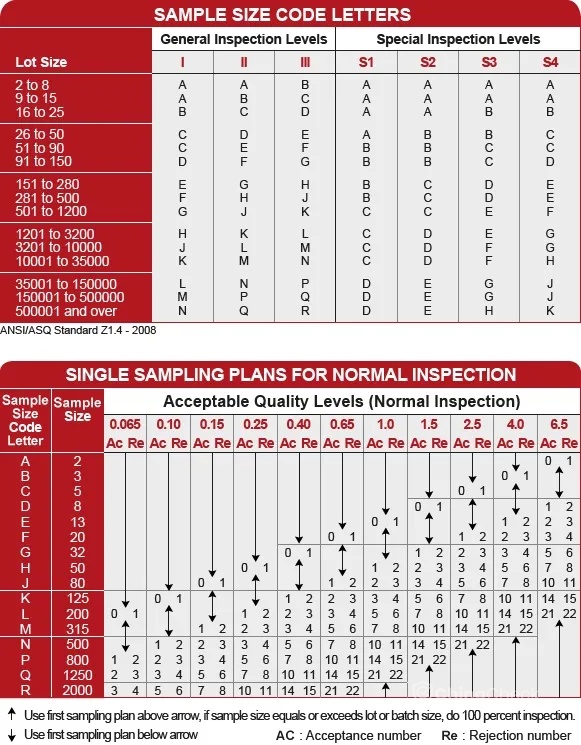
AQL – example
The AQL standard is your first line of defense against poor quality goods. But reading the tables is just the start—you need an experienced inspector who knows how to apply them correctly. That's why we recommend using a third-party quality control service like China-Check for supplier verification and factory inspections. They'll help you interpret the results and make the right call on your shipment.
- According to GI: G – 32 samples are checked. Supply suspension comes when two pieces with major defects and three pieces with minor defects are found.
- According to GII: J – 80 samples are checked. Supply suspension comes when five pieces with major defects and seven pieces with minor defects are found.
- According to GIII: K – 125 samples are checked. Supply suspension comes when seven pieces with major defects and ten pieces with minor defects are found.
Doing business with a Chinese company? Verify it before you commit
Run a verification →Verify before you pay
Get an independent due-diligence report on any Chinese company — registration, legal status, litigation and risk signals — delivered to your inbox.
Check a company now