
Importing Solar Panels from China to Europe: Tariffs, CE Marking, and EN 1090-1
Updated 2026-06-20
Over my two decades sourcing from China, I've seen solar panel imports surge—especially after the EU dropped anti-dumping duties in 2018. With zero tariffs on most photovoltaic modules and China producing over 65% of the world's supply, the opportunity for European importers is huge. But navigating compliance and quality checks is where many trips up.
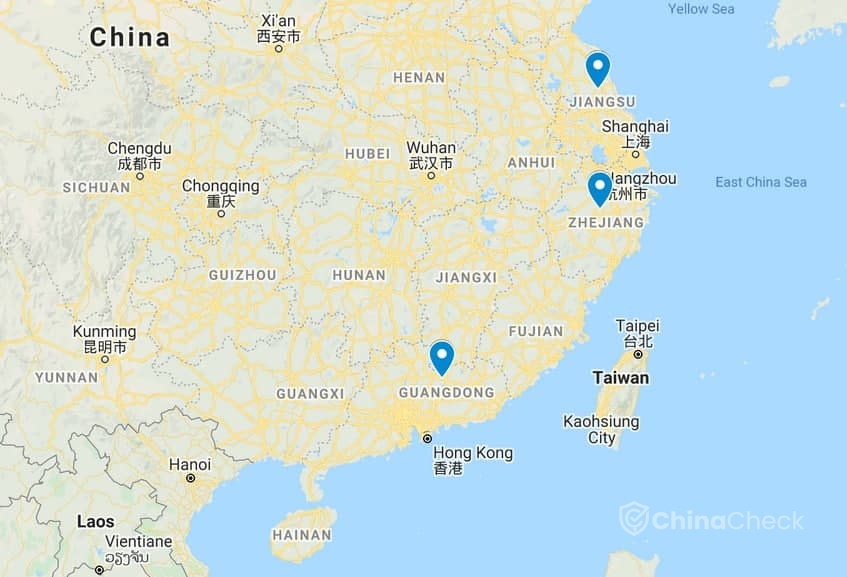
Production areas for solar panels in China
China is considered a global leader in the solar panel industry and the biggest manufacturer of such panels. According to The International Energy Agency (IEA) report for 2018, China surpassed the EU’s total capacity of installations put into operation that year (China – 45 GW; EU – 8.3 GW) and the total production capacity of installations already in usage (China – 176.1 GW; EU – 115 GW). The report also shows that China is responsible for over 65% of photovoltaic modules’ global production.
Most of the factories manufacturing such modules are located in Zhejiang, Jiangsu, and Guangdong Provinces. These are the most industrialized regions in the country, with the most significant number of Chinese photovoltaic suppliers. The majority of the top 10 companies in the world producing solar panels come from China.
Import of solar panels from China – duty rates
Before starting the import from China, one must first check the customs rates for the selected goods. One can find the duty rates on goods imported into the European Union in the TARIC system. Below we present an example of customs duty rates on photovoltaic panels along with the applicable HS codes:
- Photosensitive semiconductor devices, including photovoltaic cells whether or not assembled in modules or made up into panels; light-emitting diodes (LED) – 8541409000 – 0%
- Electrical transformers, static converters (for example, rectifiers) and inductors – 8504409090 – 0%
Both the tariffs and the fact that China is the largest producer of solar panels globally make importing them from this country beneficial. As one can see, the duty rates on solar panels imported from China to the EU are very low, and in this case, they’re zero.
Requirements for importing solar panels from China to the European Union
Although in the Chinese offer, one can find most of the photovoltaic modules, it should be remembered that they are manufactured for distribution worldwide. Therefore, they do not always comply with European requirements. That is why it is crucial to familiarize oneself with the law in force in the EU before importing and ensure that all the components comply with it.
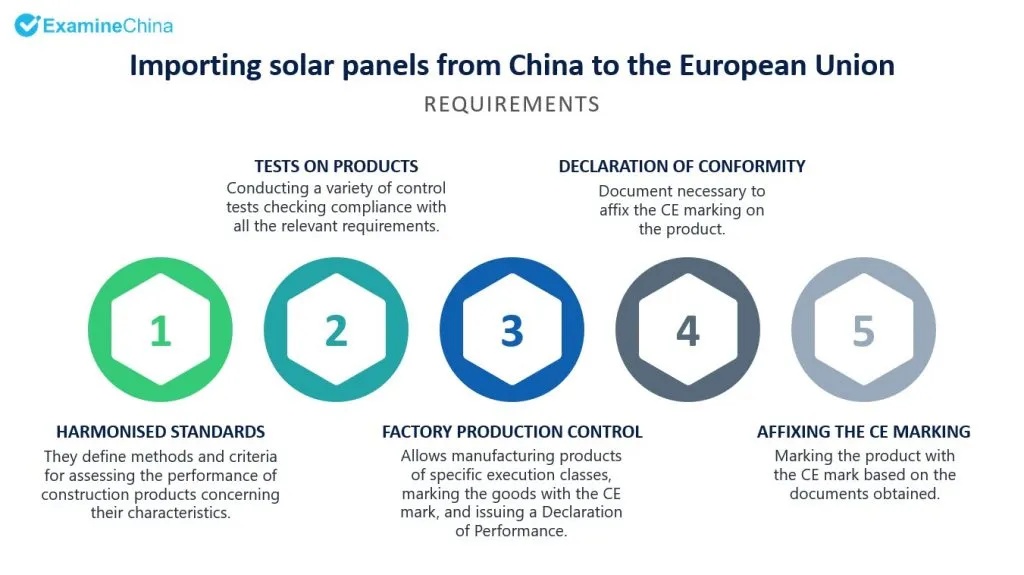
First of all, it is necessary to obtain the CE marking and all the documents related to it. To put such a mark on the panels, they must undergo tests checking their conformity to all the applicable requirements. After testing the product, the inspection company draws up a test report. It allows issuing a certificate of conformity by the certification body. Based on these documents, the manufacturer has the right to issue a declaration of conformity and affix the CE mark on the solar panels. It is also necessary to carry out tests in terms of meeting the EN 1090-1 standard. The standard concerns the introduction to the European market of a steel or aluminum building structure. It entitles the manufacturer to issue a Declaration of Performance (DoP).
Range of tests for substructures intended for the construction of photovoltaic power plants:
- Classification of products in terms of shape and dimensions for compliance with PN-EN 755-2:2016
- Classification of aluminum profiles in terms of durability according to EN 1999-1-1:2011. The structure should meet minimum class B without a protective coating. It must be confirmed that it can be used in environments with a given atmospheric corrosivity category according to EN ISO 12944-2:2018-02.
- Classification of steel elements in terms of anti-corrosion.
- Strength tests of connections.
- Testing a load of solar panels together with the supporting structure.
- Weight of modules.
Factory Production Control (FCP)
The product may be approved for use in construction based on a harmonized technical specification (hEN) or the European Technical Assessment (ETA), which allows affixing the CE mark. Furthermore, according to the EN 1090-1 standard, it is also necessary to perform an initial type test following point 6.2 of the specification. Therefore, solar panels must undergo the Factory Production Control (FCP) concerning production in a factory in accordance with the relevant harmonized technical specifications.
The FCP certificate is issued only on the basis of the 2+ conformity assessment system. It allows the plant to manufacture products of specific execution classes, to mark the goods with the CE mark, and issue a Declaration of Performance (DoP).
Importing solar panels from China to the European Union – to sum up
China is the largest manufacturer of solar panels globally. Customs tariffs for photovoltaic modules from this country are very low. That is why importing them into the European Union may be very beneficial. However, one should keep in mind that such installations must conform to many EU market requirements. Remember that importers need to check if there are any other obligations regarding solar panels in the destination country in addition to EU requirements.
China remains your best bet for cost-effective solar panels, but don't let low duties fool you—EU regulations like CE marking and Factory Production Control are non-negotiable. Before you place your next order, have a third-party inspection verify product conformity and factory standards. At China-Check, we handle supplier verification and quality control so you can import with confidence.
Doing business with a Chinese company? Verify it before you commit
Run a verification →Verify before you pay
Get an independent due-diligence report on any Chinese company — registration, legal status, litigation and risk signals — delivered to your inbox.
Check a company now