
Sourcing Rapid COVID Tests from China: Avoiding Fraud and Meeting Regulatory Standards
Updated 2026-06-20
In my two decades sourcing from China, I’ve seen demand spikes trigger a flood of scammers. The COVID-19 pandemic was no exception – rapid test kits became a gold rush overnight, and unscrupulous suppliers popped up everywhere. If you’re considering importing these tests, you need to know not just the product types, but also how to dodge fraud and navigate strict FDA or CE requirements. Here’s what I’ve learned from real deals and dirty tricks.
Types of rapid coronavirus tests from China
There are currently two types of coronavirus testing. One of them is the genetic (molecular) PCR test, recommended by the World Health Organization (WHO). The effectiveness of this test is almost 100%. To carry out the test, a swab from the upper or lower respiratory tract is taken as a sample. Results are obtained within 24-48 hours.
The second type is the rapid cassette (immunochromatographic) test. It is used to detect IgM and IgM antibodies that arise in the case of SARS-CoV-2 coronavirus infection. With its appearance and the way how it works, it resembles a pregnancy test. The undoubted advantage of these tests and the reason for their growing popularity is simplicity and speed. The test can be carried out without specialized conditions, and the results are available just within 10 minutes. Unfortunately, they are not as accurate as the aforementioned PCR genetic test.
It should be stressed that both types of tests are for laboratory use only. Besides, according to current WHO recommendations regarding the diagnosis of SARS-CoV-2 coronavirus infections, only genetic tests are recommended. Tests should be performed in biosafety level 2 laboratories.
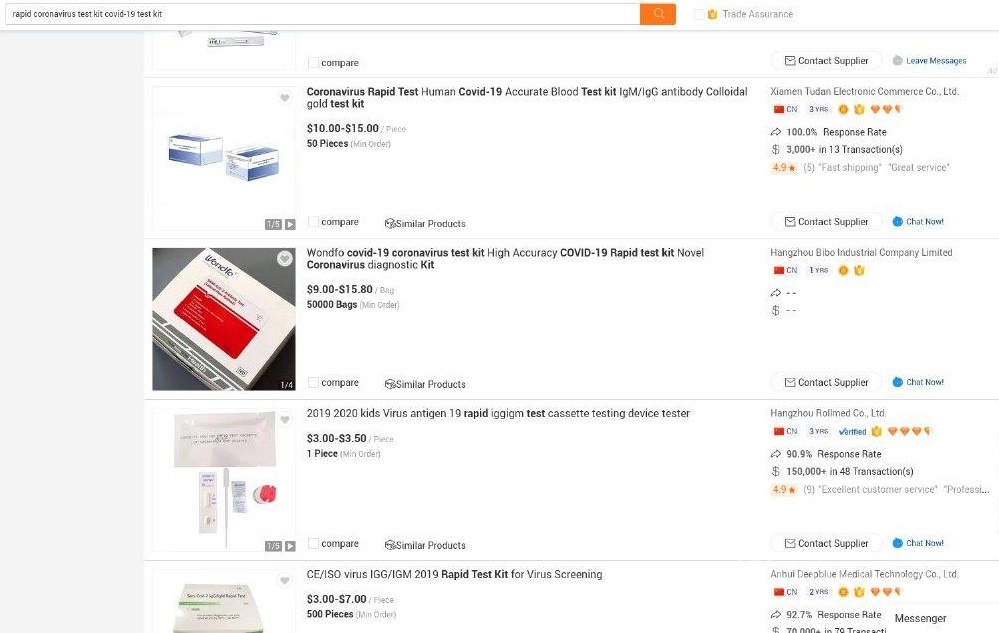
Coronavirus test kits on Alibaba – the risk of fraud
Along with the growing interest in rapid coronavirus tests from China, scammers’ activity in the Chinese market has increased, especially on B2B marketplaces like Alibaba or Made in China. This applies to all products for which there was a sudden increase in demand during the coronavirus epidemic, such as medical face masks or antibacterial gels.
First of all, rapid coronavirus tests imported from China to European Union are a medical product covered by the requirements of Directive 98/79/EC of the European Parliament and of the Council of 27 October 1998 on in vitro diagnostic medical devices. Consequently, in this type of product, CE marking must be affixed. It’s the importer’s responsibility to ensure that the product meets all EU requirements in this matter and is safe for consumers. Otherwise, it will not be approved for sale and most likely be utilized.
In the US, requirements for rapid coronavirus tests are specified in the Code of Federal Regulations Title 21 (classification: 862, 864, 866 – medical specialty panels: based on the intended use of the device and also indications for use: Classes I, II, III). Rapid tests must be approved by The US Food and Drug Administration (FDA).
Due to high demand, the number of Chinese companies offering coronavirus tests is growing rapidly. They mostly require payment in advance of min. 30% value of the order. In the case of fraud, the Chinese partner ends all communication just after receiving the money. Enforcing payment in such circumstances is virtually impossible. That’s why it’s essential to verify your new supplier before transferring money.
Remember!
Before you transfer a single dollar, get your supplier verified through a third-party inspection or factory audit. At China-Check, we specialize in supplier verification and quality control – because in a crisis, due diligence is your only safety net. Don’t let a cheap test cost you your reputation or your money.
Doing business with a Chinese company? Verify it before you commit
Run a verification →Verify before you pay
Get an independent due-diligence report on any Chinese company — registration, legal status, litigation and risk signals — delivered to your inbox.
Check a company now