
UL Certification from China: Why It Matters for U.S. and Canadian Markets
Updated 2026-06-20
In my 20 years of sourcing from China, I’ve seen too many importers assume UL certification is optional. It’s not—it’s the key to getting your product into US and Canadian retailers and building consumer trust. Skipping it can mean costly recalls or being locked out of major markets. Here’s what you really need to know about navigating UL certification for your China-sourced goods.
The UL Company
UL, which stands for Underwriters Laboratories, is a not-for-profit independent safety classification company based in Illinois. Its history reaches back to 1894, and it participated in researching the safety of many new technologies invented in the 20th century. Its core objective was, and still is, to measure the quality and safety of products entering the American and Canadian markets. The company tests a wide range of products, from home electronics to building materials, Moreover, it evaluates the conditions in which they are produced.
The UL classification mark is carried by 22 billion products annually, and the company is active in 46 countries all over the world. Among products evaluated by the UL are electronics, building materials, industrial control equipment, wires and electric cables, photovoltaics, and others.
UL Certification Mark
The UL evaluates various kinds of products, processes, and facilities and can issue over 20 types of certifications. These are usually tailored for a specific country, so they will not be recognized everywhere. It is important to know that a product cannot just be “UL approved.” After passing the tests, it will be classified as one of these three categories instead:
- UL Listed signifies that a product has met all expected quality standards and has been tested for safety. This mark is put on products ready to enter the market and be sold to consumers.
- UL Recognized does not focus on the finished product but its components. In this case, the UL approves all parts and machinery used to make the object. It usually is used to classify power supplies and equipment used by workers. The “Recognized” stamp is generally easier to obtain than the “Listed” one.
- UL Certified is used when the product has been tested according to outside authority standards, such as a specific city’s construction code.
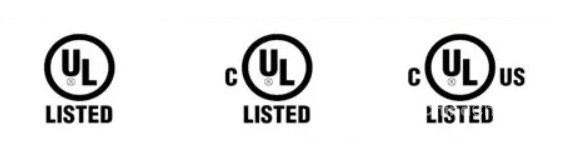 Listing mark for the US, mark for Canada, mark for the US & Canada
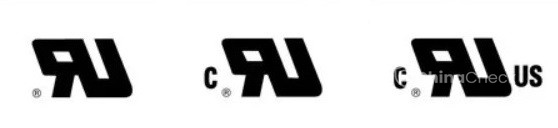 Recognition mark for the US, mark for Canada, mark for the US & Canada
UL vs. CE
The main difference between the two is that the UL is valid in the US and Canada, while the CE is needed in the European Union. Unlike the CE mark, UL certification is not required by law. Still, it is almost impossible to sell products on the American and Canadian markets without them being evaluated by the UL, as a positive assessment indicates that a product can be trusted and is more sought out by consumers. Also, many municipalities in the US require a product to be tested in a nationally recognized laboratory, which does not have to be but often is the UL, before it can be sold. Non-UL-certified equipment can also make it more difficult to receive insurance coverage in case of any incident.
How to get the UL mark for your goods?
UL stamps can be incredibly helpful, if not essential when marketing products. Acquiring them will lessen all possible risks and help you protect your brand’s reputation. Here are the steps you need to take to get one of the previously mentioned UL marks of approval:
- Visit the UL website, and click on the “Contact Us” section. There you will find all the essential information about how and where to send your sample product and the required forms to fill out.
- Send a sample of the product to the UL for it to be tested. Ensure that it is safely packaged so that it will not get damaged during transport. You need to cover all the costs of handling and shipping.
- Wait for the UL to check whether your goods fulfill all their requirements. After the tests, the UL charges a fee for their work.
- If the product passes all the tests and is up to the expected criteria, a certificate is issued to the product’s manufacturers. Therefore, the UL logo is placed on the produced items. Remember that audits will be conducted regularly to check whether your product and the way it is manufactured are still up to standards.
Why is the UL certification important?
UL certification may add cost and time, but it’s an investment that pays off in market access and credibility. When sourcing from China, work with a supplier who understands UL standards—and use third-party verification to confirm compliance before shipping. China-Check’s factory inspections and pre-shipment quality control can help you avoid Common pitfalls. Contact us to ensure your product meets UL requirements from factory floor to store shelf.
Doing business with a Chinese company? Verify it before you commit
Run a verification →Verify before you pay
Get an independent due-diligence report on any Chinese company — registration, legal status, litigation and risk signals — delivered to your inbox.
Check a company now