
Why Baidu Dominates China Search and What It Means for Your China Marketing Strategy
Updated 2026-06-20
If you're sourcing from China, you already know the supply chain is different—but have you thought about your digital marketing strategy? In China, Google is essentially nonexistent, and Baidu holds over 80% of the search market. Ignoring Baidu means you're invisible to Chinese buyers, partners, and even your own factory's management. After 20 years of helping US businesses navigate China, I can tell you: adapting to Baidu is non-negotiable for any brand serious about the Chinese market.
Baidu
The history of Baidu started in 2000. The company’s founder, Robin Li, somehow contributed to creating his greatest competitor. Google used his patent to create a page indexing mechanism called PageRank. When Li realized how big is the success of Brin and Page, he no longer hesitated – and this is how Baidu was founded. In the beginning, the company struggled to survive, but the Chinese internet developed so fast that Baidu jumped on the bandwagon. The company was not sold to some influential and strong market players, as happened to many others, but it went public on NASDAQ – doubling the value of market shares during the years 2005-2007.
Google was Baidu’s biggest competitor all along – the American company entered the Chinese market in 2006. Although Google marked a significant presence in the Chinese search engine market, it also faced heavy criticism from the Western media for complying with China’s censorship policies. On the other hand, the Chinese government often arbitrarily blocked several services, making Google services unstable in China.
Baidu implemented Google’s ideas: it developed its own Maps, Reader, and AdSense engine. Another service responsible for the big amount of network traffic was Baidu mp3: users were able to either listen to or download their favorite songs without paying a penny, which was more attractive than anything Google could offer. Since 2009, amid growing criticism and hacking incidents, Google has withdrawn from the Chinese search engine market. Google and its services are now blocked in China.
Baidu’s philosophy is about simplicity: “unless necessary, never increase an entity.” The main page is user-friendly, has no irritating add-ons or useless functions, and works quite well even on technologically outdated equipment (and on Windows XP + Internet Explorer software combination, still very popular in China). Some of the services offered by Baidu, such as Baidu mp3 or Baidu Documents, may facilitate violations of copyright since it is not strictly followed in China.
No wonder the Chinese government is believed to back Robin Li’s company. According to the well-known premises of the Go Global policy, China is “planting” some powerful corporations on its fertile ground first, and then those companies can join the global competition. Baidu has already opened its offices in Singapore, Australia, and the USA, and its search engine works in Japan. The examples of Weibo and Huawei tell us that for a Chinese company that deals in the IT business, “going global” is challenging because potential foreign clients have many concerns over privacy and data security.
China’s search engine market
The search engine market in China is dominated by Baidu. It is the biggest for all platforms (84.3%), desktop (57.9%), and mobile (94.51%).
Search engine market across all platforms (desktop&mobile)
- Baidu: 84.3%
- Bing: 6.7%
- Sogou: 3.08%
- Google: 2.5%
- Other: 3.42%
Foreign companies on the Chinese internet
No matter what the global future of Baidu will look like, the company is the unquestionable leader in its native market. But how the entrepreneur investing in China can use the power of Baidu? One way to boost your online business is by using SEO and SEM techniques. Similar to Google, Baidu also offers SEO services. See the example of the Chinese smartphone manufacturer Xiaomi.
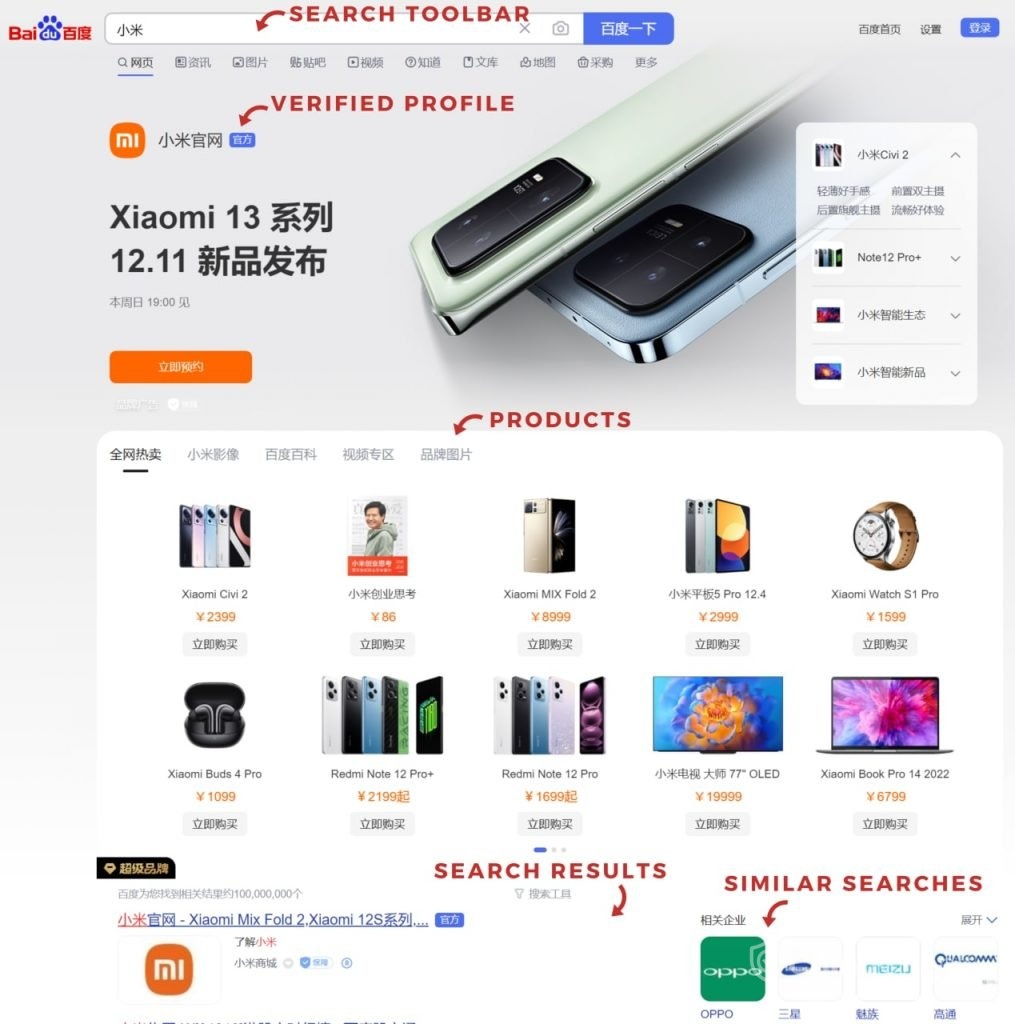
As we can see, the information about the products is presented in a neat, eye-catching way. We need to remember that in order to achieve marketing success in China, we need to cooperate with Chinese partners who know better what the Chinese internet looks like. Therefore we should buy our domain there, set up a webpage written in correct and plain (not automatically translated, of course) Chinese, find SEO/SEM agency there, etc.
The bottom line: Baidu isn't optional in China—it's the gateway to visibility and trust. Whether you're optimizing your supplier's website or launching your own brand there, work with local experts who understand Baidu's algorithm and regulatory landscape. And before you invest, make sure your supply chain is solid. China-Check offers supplier verification and factory inspections to ensure your partners are as reliable as your marketing strategy. Get the fundamentals right first.
Doing business with a Chinese company? Verify it before you commit
Run a verification →Verify before you pay
Get an independent due-diligence report on any Chinese company — registration, legal status, litigation and risk signals — delivered to your inbox.
Check a company now